Choosing insulation involves more than picking a thickness and placing an order. The type of EPS, its density, compressive strength, R-value, thickness and intended application all affect whether the material is appropriate for the job.
Expanded polystyrene, commonly called EPS, is used in a wide range of building applications, including wall systems, roofing, foundations, below-slab insulation, perimeter insulation and projects where insulation needs to support loads. Benchmark Foam manufactures several grades of EPS that meet ASTM C578 specifications, with different physical properties suited to different applications.
If you are buying EPS insulation for a new construction project, renovation, commercial building, roofing system or below-slab application, this guide walks through the specifications that matter and the questions worth answering before you place an order.
What Is EPS Insulation?
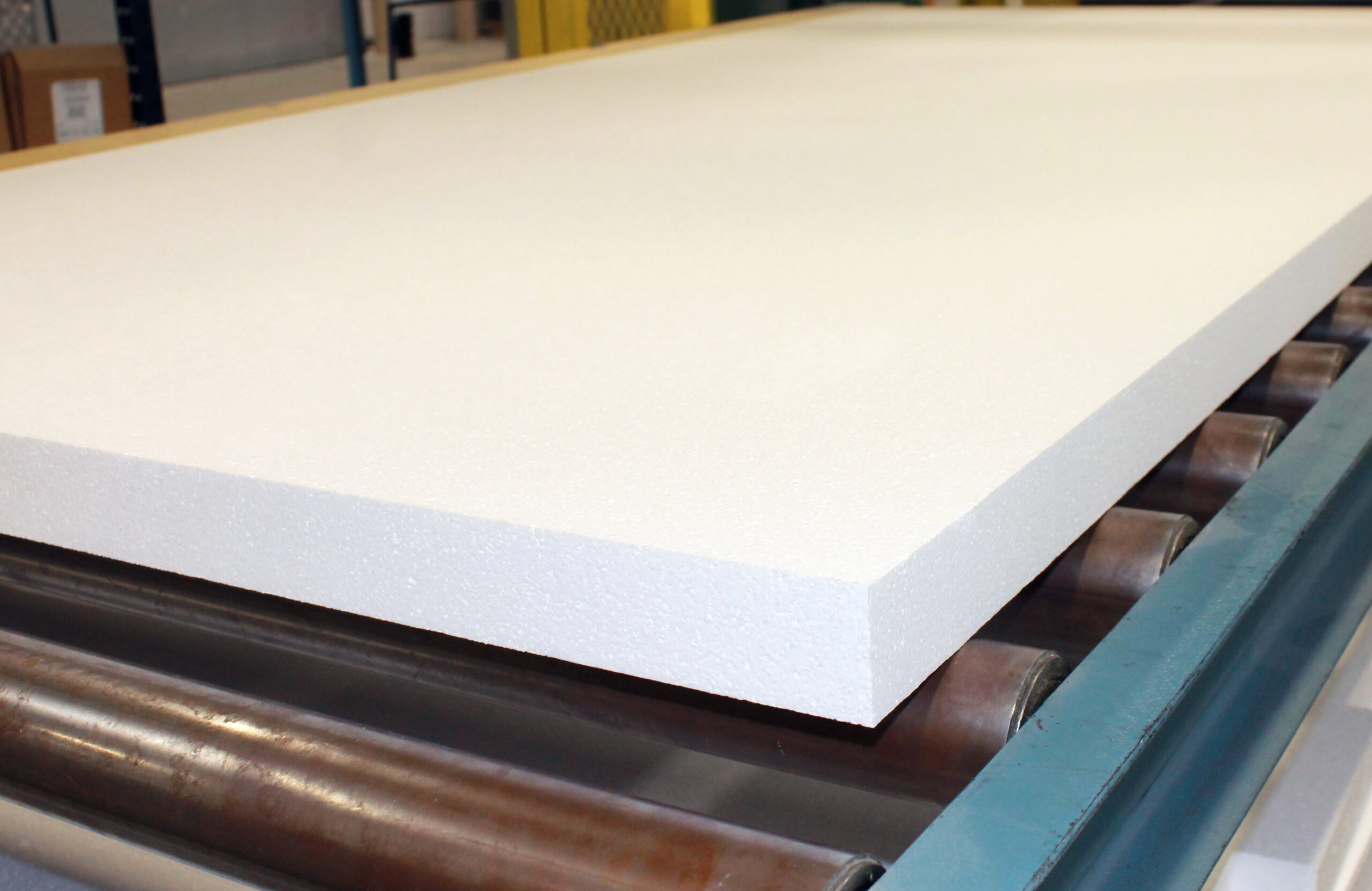
EPS stands for expanded polystyrene. It is a rigid foam insulation made by expanding small polystyrene beads and forming them into blocks, billets, boards and other shapes.
The finished material contains small pockets of air. Those air pockets help slow the movement of heat through the insulation, which gives EPS its thermal resistance. Unlike some other rigid foam products, EPS does not depend on retained blowing agents for its insulating properties. Benchmark Foam’s technical information lists R-values based on ASTM test methods and provides thermal resistance at different mean temperatures.
EPS is also available in different densities. As density increases, the material generally provides greater compressive strength. That makes the density and strength of the EPS important when the insulation will be installed beneath concrete, foundations or other areas where the material may carry a load.
In other words, the insulation you need for an attic application may not be the same type you would specify beneath a concrete slab.
Start With the Application
Before comparing EPS types, determine where the insulation will be installed and what it will need to do.
Some common applications include:
- Exterior wall insulation
- Attic and roof insulation
- Commercial roofing systems
- Below-slab insulation
- Perimeter insulation
- Foundation insulation
- Insulation beneath heated floors
- Geotechnical applications
- Insulated Concrete Form (ICF) systems
- Tapered roofing systems
The location tells you what specifications deserve the most attention.
For example, insulation installed beneath a concrete slab needs enough compressive strength to support the loads placed above it. Roofing insulation may need to meet a specified R-value while also fitting a particular drainage design. Wall insulation may place more emphasis on thickness, thermal resistance, dimensions and installation requirements.
Starting with the application prevents you from comparing products based on a single number.
Understanding EPS Types
EPS is classified by type under ASTM C578. The different types have different minimum densities and physical properties.
Benchmark Foam’s roofing insulation information lists the following common EPS grades:
| EPS Type | Nominal Density | Minimum Density |
|---|---|---|
| Type I | 1 lb/ft³ | 0.90 lb/ft³ |
| Type VIII | 1 1/4 lb/ft³ | 1.15 lb/ft³ |
| Type II | 1 1/2 lb/ft³ | 1.35 lb/ft³ |
| Type IX | 2 lb/ft³ | 1.80 lb/ft³ |
As the density increases, the minimum compressive strength also increases. This is one reason higher-density EPS is commonly selected for applications where insulation will experience greater loading.
The EPS type should therefore be selected based on the requirements of the application rather than assuming that a higher number is automatically better for every project.
EPS Density: Why It Matters
Density is typically expressed in pounds per cubic foot or pcf.
It describes how much the EPS material weighs for a given volume. Density also has a relationship with the material’s mechanical properties.
For example, Benchmark Foam lists Type IX EPS at a minimum density of 1.80 pcf and a minimum compressive strength of 25 psi at 10% deformation. Type I has a lower minimum density of 0.90 pcf and is intended for applications with different load requirements.
When reviewing a project specification, look for the required EPS type or minimum compressive strength. If the specification calls for a particular load-bearing capacity, that requirement should guide the selection.
This is especially important for insulation placed beneath slabs, floors, foundations, parking areas and other loaded surfaces.
Understanding Compressive Strength
Compressive strength describes how much pressure EPS can withstand before reaching a specified amount of deformation.
EPS technical data commonly reports compressive strength at 10% deformation using ASTM D1621.
For example, Benchmark Foam’s Type IX EPS has a listed minimum compressive strength of 25 psi at 10% deformation. Its Type VIII EPS has a lower minimum strength because it has a lower minimum density.
When selecting insulation for a below-slab application, the question is not simply, “What R-value do I need?”
You also need to ask:
- What loads will the insulation support?
- What is the expected load over the slab?
- Is the load distributed across the slab or concentrated in specific areas?
- Does the project specification identify a minimum compressive strength?
- Will equipment, vehicles, stored materials or other loads be present?
The answer to these questions can affect which EPS type is appropriate.
R-Value and Thermal Resistance
R-value measures resistance to heat flow. A higher R-value indicates greater resistance to heat transfer.
With EPS, R-value depends on the material’s properties, density, temperature and thickness. Benchmark Foam’s technical data reports thermal resistance at 25°F, 40°F and 75°F mean temperatures.
For residential construction, the Federal Trade Commission uses R-values determined at a 75°F mean temperature when calculating residential R-values.
Thickness also matters. If a project requires a particular total R-value, the required insulation thickness should be determined from the specified EPS type and the applicable R-value.
For example, Benchmark Foam’s Type IX technical data lists an R-value of 4.35 per inch at 75°F. The same material has a higher listed R-value at lower temperatures.
When comparing insulation products, make sure you are comparing R-values using the same temperature and testing basis. Looking at one product’s R-value at 75°F and another product’s value under a different condition can lead to a misleading comparison.
Thickness Is Part of the Specification
Thickness affects both thermal resistance and how the insulation fits into the building assembly.
A project may call for a specific R-value, a specific thickness or both. In a below-slab installation, available space can also affect the decision because the insulation occupies part of the overall slab assembly.
Benchmark Foam manufactures EPS insulation in different thicknesses and applications, including roofing systems and high-density insulation for below-slab use.
If a project requires R-10 insulation beneath a heated slab, for example, the required EPS thickness needs to be considered when determining the overall slab elevation and construction design. Benchmark Foam has documented several EPS configurations used for R-10 applications, including 2.5-inch and 2.3-inch products with different compressive strengths.
This is one reason it helps to review insulation requirements before concrete placement, roofing installation or other work that depends on the final assembly dimensions.
Choosing EPS for Below-Slab Applications
EPS is frequently used beneath concrete slabs because it provides both thermal insulation and load-bearing capacity.
For these applications, buyers typically need to consider:
- EPS type
- Compressive strength
- R-value
- Thickness
- Slab loading
- Installation conditions
- Moisture exposure
- Required dimensions
The insulation needs to support the loads transferred through the slab while providing the specified thermal resistance.
Higher-density EPS grades can provide greater compressive strength. Benchmark Foam’s Type II and Type IX products are listed with higher minimum compressive strengths than lower-density grades and are used in applications such as insulation beneath concrete slabs and other areas where greater load resistance is needed.
If the insulation will be installed beneath a radiant or hydronic heated floor, the required R-value and compressive strength should both be considered. The insulation also needs to fit within the available slab design.
Choosing EPS for Roofing
EPS is also used as rigid roof insulation, including tapered roofing systems.
A tapered EPS system can be designed with varying thicknesses to create slopes that direct water toward drains. This can be useful on low-slope roofs where drainage needs to be incorporated into the insulation assembly.
Benchmark Foam manufactures EPS roofing boards and tapered roofing systems in standard and project-specific configurations. Its roofing information also notes that insulation can be installed in multiple layers with staggered joints to reduce thermal bridging.
When buying EPS roof insulation, review:
- Required R-value
- Minimum insulation thickness
- Roof slope and drainage requirements
- EPS type
- Board dimensions
- Number of insulation layers
- Attachment method
- Compatibility with adhesives and roofing materials
- Moisture exposure during installation
The roofing assembly should determine the insulation requirements rather than selecting the EPS independently from the rest of the roof system.
Moisture Considerations
EPS varies from other insulation materials in that its composition allows it to breathe, but EPS is not a waterproofing system, so moisture exposure still needs to be considered during installation and throughout the building assembly.
Benchmark Foam’s roofing guidance recommends temporarily protecting EPS from moisture exposure during installation and replacing wet insulation or allowing it to dry thoroughly before continuing the roofing application.
EPS technical data also includes water absorption measurements. For example, Benchmark Foam lists maximum water absorption by total immersion for its Type IX EPS at less than 2% by volume.
The specific moisture conditions of the project should therefore be reviewed when selecting and installing EPS.
EPS and Vapor Permeance
EPS is not a vapor barrier.
Its water vapor permeance varies by type and thickness. Benchmark Foam’s technical data lists water vapor permeance values using ASTM E96, with lower permeance values associated with some of the higher-density EPS grades.
Whether a vapor retarder is needed depends on the building assembly, climate, interior conditions and applicable building requirements.
For roofing applications, Benchmark Foam recommends evaluating each roof assembly to determine whether a vapor retarder is needed to control internal condensation.
This decision should be made as part of the overall building design rather than based on the insulation alone.
Be Careful With Adhesives and Solvents
Not every adhesive or construction chemical is suitable for use with EPS.
Petroleum-based solvents, certain adhesives and coal tar pitch products can attack EPS. Benchmark Foam recommends using adhesives approved for EPS applications and preventing direct contact with incompatible products and their vapors.
This is an easy specification to overlook when several materials are being installed as part of the same assembly.
Before installation, check the compatibility of:
- Adhesives
- Coatings
- Sealants
- Roofing products
- Solvents
- Waterproofing materials
- Other chemicals that may contact the EPS
Following the product manufacturer’s compatibility requirements can prevent damage to the insulation before the assembly is completed.
EPS vs. Other Rigid Foam Insulation
EPS is one of several rigid foam insulation products available for construction.
Depending on the project, buyers may also encounter XPS and polyisocyanurate, commonly called polyiso.
The products differ in thermal properties, moisture behavior, density, compressive strength, temperature characteristics, cost and testing methods.
One important point is that R-values should be compared using the same testing conditions. Benchmark Foam notes that EPS should not be compared directly with polyisocyanurate using R-values based on different conditioning standards.
The right comparison depends on what the project requires.
If the specification calls for a particular compressive strength, R-value, thickness or ASTM classification, start there rather than choosing a material based on a general statement about which insulation has the highest R-value.
What to Ask When Buying EPS Insulation
Before requesting a quote, gather as much project information as possible.
A supplier will typically need to know:
- Where will the EPS be installed?
- Identify whether the insulation is going beneath a slab, around a foundation, within a wall, above a roof deck, beneath a roof membrane or in another location.
- What EPS type is required
- Check the architectural drawings, engineering specifications or project requirements for an ASTM C578 type.
- What compressive strength is required?
- For load-bearing applications, provide the required minimum compressive strength.
- What R-value is required?
- Identify the target R-value and the temperature basis being used.
- What thickness is required?
- Provide the required insulation thickness or the available space within the assembly.
- What are the board dimensions?
- Standard 4-by-8-foot boards may work for some applications, while other projects may require different dimensions or shapes..
- Are tapered boards required?
- Roofing projects may require slopes, crickets, saddles or other tapered components for drainage.
- How much insulation is needed?
- Provide square footage and account for the thicknesses and configurations required throughout the project.
- When is the insulation needed?
- The delivery schedule matters because insulation often needs to arrive before another trade can begin.
- Are there project-specific requirements?
- Include drawings, specifications, details, engineering requirements or other documents that identify the insulation properties needed.
Having these details available makes it easier to identify the appropriate EPS product and prepare a quote based on the actual project requirements.
EPS Insulation Buying Checklist
Before ordering, review the following:
Application
- Where will the EPS be installed?
- What will be above or below it?
- Will it carry a structural or distributed load?
Material
- EPS type
- Minimum density
- Compressive strength
- R-value
- Thickness
- Water vapor permeance
- Water absorption
Dimensions
- Board length and width
- Thickness
- Number of layers
- Tapered sections or specialty shapes
Installation
- Adhesive compatibility
- Moisture exposure
- Temperature exposure
- Required protective coverings
- Applicable building codes
Project logistics
- Total square footage
- Quantity by thickness
- Delivery location
- Required delivery date
- Drawings or specifications
- Getting the Right EPS for Your Project
EPS insulation works across a broad range of construction applications, but the specifications should match the job. Density, compressive strength, R-value, thickness, moisture exposure, temperature and installation conditions all have a place in the selection process.
The best starting point is the project specification. From there, compare the required properties with the manufacturer’s technical data and confirm that the selected EPS type and thickness fit the building assembly.
Benchmark Foam provides EPS insulation for roofing, below-slab, perimeter, foundation, wall and other construction applications. Its technical data includes ASTM test information for the different EPS types, giving contractors, designers, engineers and purchasing teams the information needed to compare material specifications.
Need EPS Insulation for an Upcoming Project?
Have your required R-value, thickness, EPS type, compressive strength, dimensions and quantity available and Benchmark Foam can help you determine the appropriate material for your application. Contact us today to request a quote.