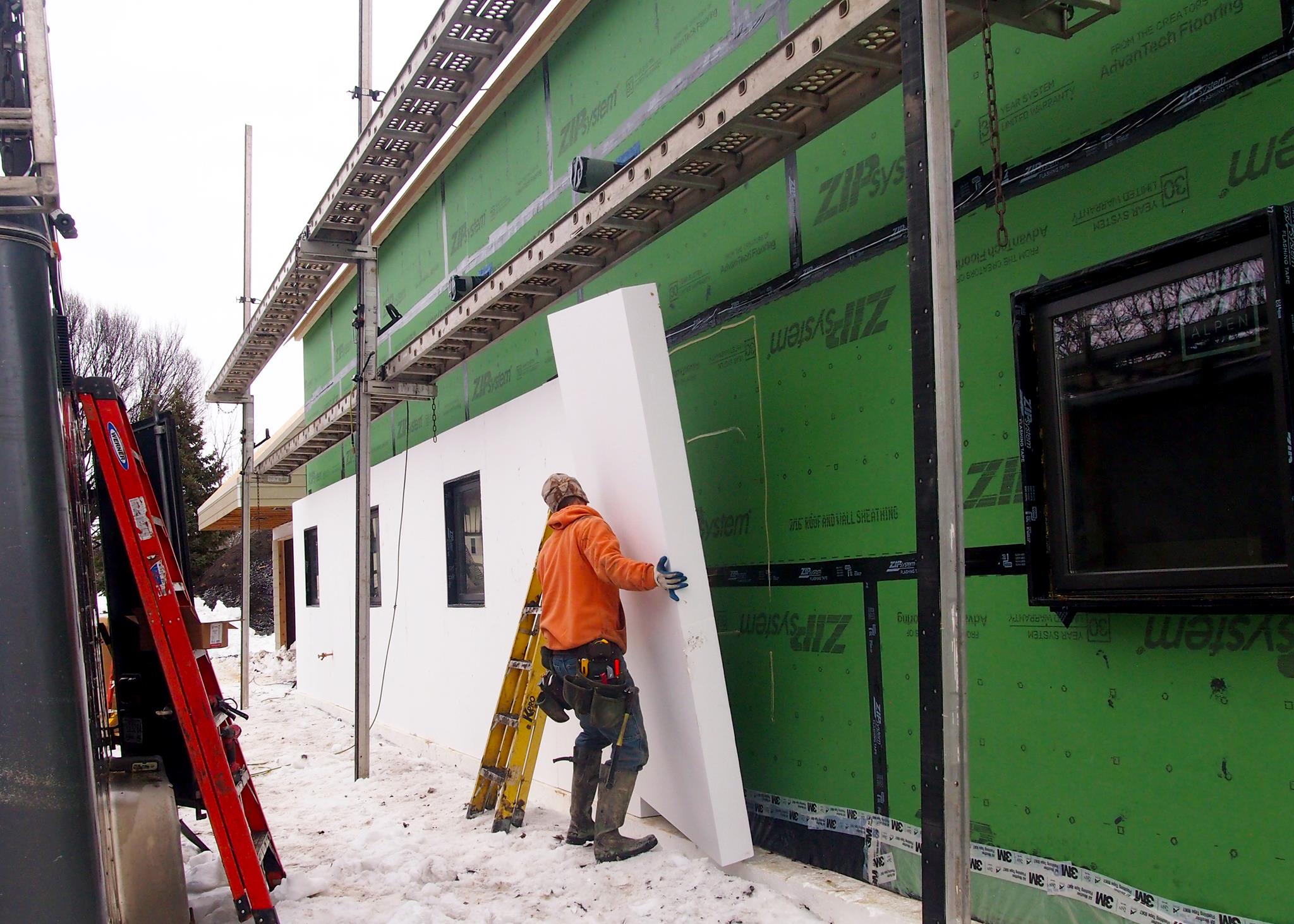
When people hear the term insulation, they often think about insulation inside a wall or beneath a roof. At Benchmark Foam, we see expanded polystyrene (EPS) insulation used in many other parts of construction and manufacturing, including foundations, concrete slabs, structural insulated panels, heated floors and geotechnical projects.
We manufacture EPS in several densities and forms because different applications call for different physical properties. Understanding those differences can help builders, contractors and engineers select the appropriate insulation foam for a project.
What Is Foam Insulation?
Expanded polystyrene foam insulation is made from small polystyrene beads that are expanded and molded into boards, blocks and other shapes.
EPS insulation is available in different densities. As density increases, the physical properties of the material change, including its compressive strength and thermal resistance. That makes density an important consideration when selecting insulation for a particular application.
We test our EPS products for properties such as density, R-value, compressive strength and water absorption. These measurements provide useful information about how a particular grade will perform in a specific environment.
Types of EPS Foam Insulation
We manufacture several types of EPS foam for different construction requirements.
Type I EPS has a nominal density of 1.0 lb/ft³ and a minimum compressive strength of 10 psi at 10% deformation. It can be used in applications such as residential insulation and roofing.
Type II EPS has a nominal density of 1.5 lb/ft³ and a minimum compressive strength of 15 psi at 10% deformation. This higher-density material can be used for applications including sub-slab insulation and bridge embankments.
For projects requiring greater compressive strength, we also manufacture higher-density grades such as Type VIII and Type IX EPS. Type IX has a nominal density of 2.0 lb/ft³ and a minimum compressive strength of 25 psi at 10% deformation.
The appropriate grade depends on factors such as where the insulation will be installed, the loads it will experience and the thermal resistance required.
Where Foam Insulation Is Used
EPS insulation can serve several purposes throughout a building or construction project.
In residential construction, EPS can be used around foundations, inside walls, in attics and as the insulating core of structural insulated panels. We also manufacture PreFirred EPS insulation for applications involving concrete and masonry walls.
In commercial roofing, EPS can provide thermal insulation across large roof areas. We also manufacture tapered EPS roofing insulation, which directs water toward roof drains.
For concrete slabs and foundations, the compressive strength of the insulation becomes especially important. Higher-density EPS can be placed beneath slabs where the foam needs to support the loads above it while also reducing heat transfer between the building and ground.
We also manufacture Geofoam, a lightweight EPS product used in geotechnical construction. Geofoam can replace heavier fill materials in applications such as roadway embankments and other projects where reducing the weight placed on underlying soil is useful.
Another application is in-floor heating. Our Thermo-Snap® panels are made from EPS and are designed to be installed beneath heated flooring systems. The insulation securely holds the pex tubing in appropriate spacing, making installation simpler and more cost-effective.
Why Material Properties Matter
R-value is one of the most familiar measurements associated with insulation foam. It describes resistance to heat flow, while k-value describes thermal conductivity. Looking at these values helps determine how much insulation may be needed for a particular application.
Thermal performance is only one consideration, though. Compressive strength matters when insulation will support a slab or other load. Water absorption and vapor permeance are also important when the material will be exposed to moisture.
Selecting the Right Insulation Foam
Choosing insulation starts with understanding what the material needs to do. Consider the location of the insulation, expected loads, moisture exposure, required R-value, thickness and surrounding conditions.
At Benchmark Foam, we manufacture EPS products for a wide range of applications, from residential and commercial construction to roofing, heated floors and geotechnical projects. By comparing the properties of each EPS grade with the requirements of the project, contractors and engineers can select a material suited to the job.