
Type II EPS Technical Data
Since 1988, Benchmark Foam has operated on a simple promise: that our products and our people should be the standard others are measured by. Our Type II Expanded Polystyrene (EPS) is a powerful embodiment of this principle. Engineered for projects demanding a greater level of strength, this insulation is a cost-effective, durable and energy-efficient solution for challenging applications. Type II EPS is your go-to material for bridge embankments, commercial roofing and under concrete slabs, where its enhanced physical properties provide lasting performance and reliability.
We hold our products to the strictest industry standards, including ASTM C578, but our dedication to quality often pushes us to exceed these benchmarks, creating a product you can trust to perform day in and day out.
Detailed Properties of Type II EPS
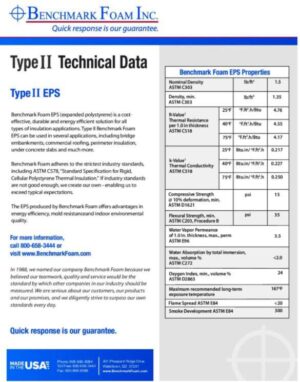
The following table outlines the key physical properties of our Type II EPS and provides you with the definitive data needed for your specifications and designs.
As you can see, the higher density of Type II EPS gives it a slightly improved thermal resistance compared to lower-density types, making it a smart choice for energy-efficient building envelopes.
| Nominal Density ASTM C303 | lb/ft3 | 1.5 | |
| Density, min. ASTM C303 | lb/ft3 | 1.35 | |
| R-Value1 Thermal resistance per 1.0 in thickness ASTM C518 | 25°F | °F·ft2·h/Btu | 4.76 |
| 40°F | °F·ft2·h/Btu | 4.55 | |
| 75°F | °F·ft2·h/Btu | 4.17 | |
| k-Value1 Thermal conductivity ASTM C518 | 25°F | Btu·in/°F·ft2·h | 0.217 |
| 40°F | Btu·in/°F·ft2·h | 0.227 | |
| 75°F | Btu·in/°F·ft2·h | 0.250 | |
| Compressive Strength @ 10% deformation, min. ASTM D1621 | psi | 15 | |
| Flexural Strength, min. ASTM C203, Procedure B | psi | 35 | |
| Water Vapor Permeance of 1.0 in. thickness, max., perm ASTM E96 | 3.5 | ||
| Water Absorption by total immersion, max., volume % ASTM C272 | <2.0 | ||
| Oxygen Index, min., volume % ASTM D2863 | 24 | ||
| Maximum recommended long-term exposure temperature | 167°F | ||
| Flame Spread ASTM E84 | <20 | ||
| Smoke Development ASTM E84 | 300 | ||
Understanding the Numbers
Strength and Structural Integrity
The strength of our Type II EPS comes from its higher density. With a strength of 15 psi, it’s built for handling heavy loads (like under concrete slabs or in foundation walls) without losing its insulating value. It provides a stable, firm base that won’t break down over time.
Moisture Management and Breathability
Like all grades of EPS, Type II has a closed-cell structure that resists moisture, which helps prevent mold and supports a healthier building. While it’s not a vapor barrier, it can breathe, allowing moisture to escape wall assemblies and preventing buildup. This natural breathability often removes the need for the expensive venting systems that other insulations require.
It’s worth noting that liquid water can move through the tiny channels between the fused EPS beads via capillary action, which is why proper installation and protection from constant water exposure are key for long-term performance.
Fire Safety and Flammability
Like many construction materials used in building envelopes, EPS is combustible and should be installed with all appropriate safeguards as required by local building codes. The Oxygen Index test (ASTM D2863) measures the minimum concentration of oxygen required to support a flame under very specific laboratory conditions.
Important Safety Note: This test does not indicate how the material will perform in a real fire. When exposed to high heat, EPS will not continue to burn on its own; it will melt away. For safe use, it is essential that the installation includes proper protection, such as a thermal barrier, separating the insulation from the building’s interior.
Long-Term Stability and Protection
To maintain its integrity and performance, EPS should be covered or finished when prolonged exposure to sunlight is expected, as ultraviolet (UV) radiation can cause surface dusting or discoloration. While EPS performs well across a broad temperature range, it is also important to note that it may experience dimensional changes when continuously exposed to temperatures above its maximum recommended long-term exposure temperature of 167°F. In roofing and other exterior applications, this is managed with the use of appropriate coverings or membranes.
Downloadable data sheet

The Right Choice for Demanding Applications
Choosing Benchmark Foam’s Type II EPS means selecting a material that brings together proven performance and enhanced durability. Its balanced profile of thermal efficiency, moisture resistance and structural strength makes it an incredibly versatile solution for your most demanding projects.
We are serious about our customers, our products and our promises. Our team diligently strives to surpass our own standards every day, and a quick, helpful response is our guarantee.
Let us help you build something better. Contact Benchmark Foam today to discuss how Type II EPS can meet the needs of your next project.