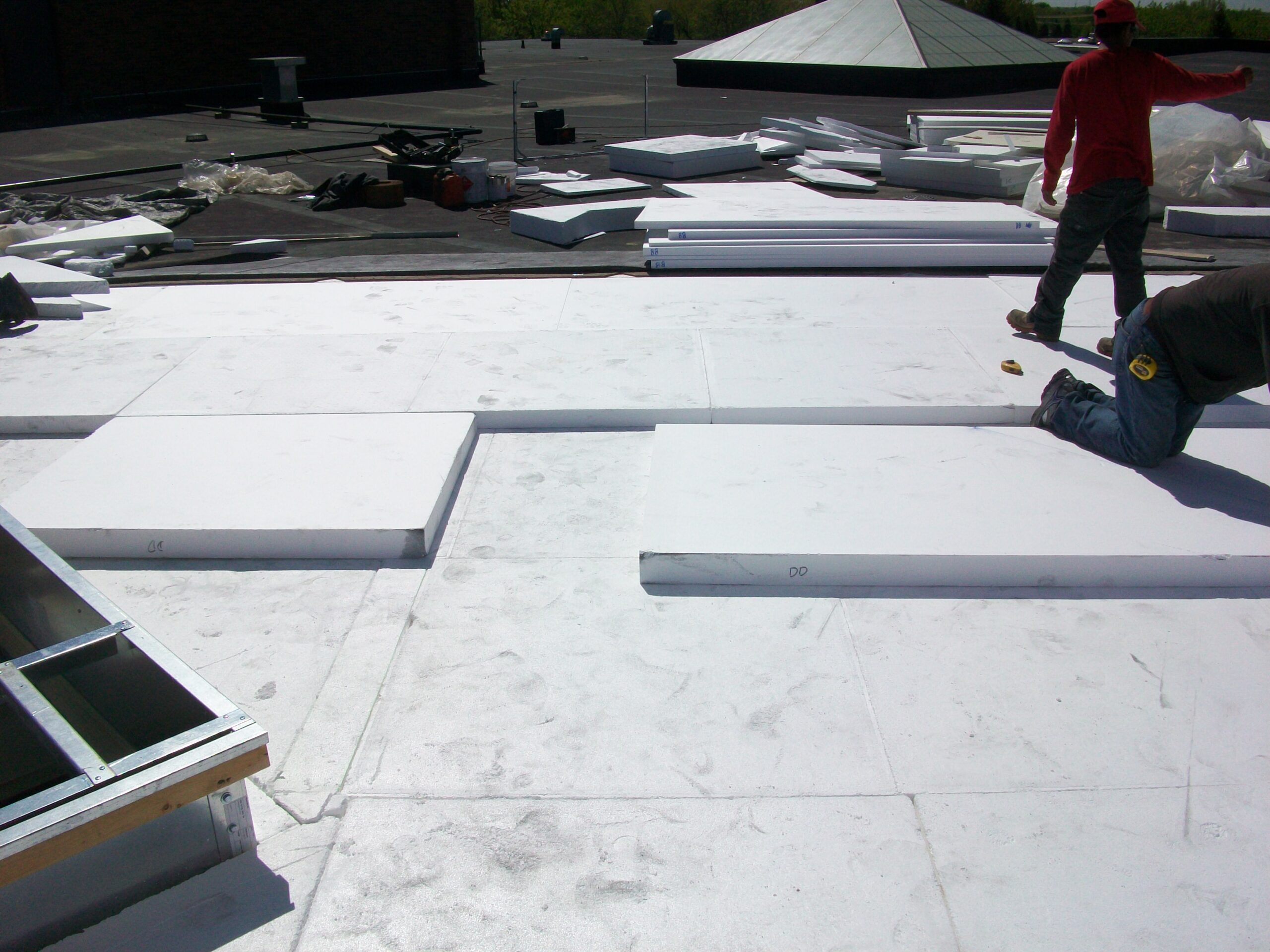
When it comes time to choose insulation for a commercial or residential roof, the number of options can feel overwhelming. While each material has its place, they are not the same. Understanding how expanded polystyrene (EPS) stacks up against traditional options helps you make a smarter choice for your building and your budget.
Cost Per R-Value
The most straightforward way to compare insulation is to look at R-value, which measures how well a material resists heat flow where a higher number equals better thermal performance. Traditional fiberglass offers about R-2.9 to R-3.8 per inch, while polyiso delivers a higher R-5.6 to R-6.8 per inch, but that performance comes at a steep price.
EPS Roof Insulation falls in the middle for thermal performance, with R-4.1 to R-4.7 per inch depending on density. Where EPS wins is the cost per R-value. EPS is the most affordable rigid foam board on the market, often costing about half what ISO runs while delivering essentially the same thermal resistance. Fiberglass costs less upfront, but it does not offer the rigidity, moisture resistance and long-term stability of EPS.
What Happens When Water Shows Up?
Roof insulation gets wet sometimes. Leaks happen and cause condensation. The question is what happens to the insulation after it gets wet.
EPS has a closed-cell structure that is resistant to moisture absorption. It absorbed only about 5% moisture in independent 15-year field testing, while XPS absorbed nearly 19% under the same conditions. More importantly, EPS retained 94% of its original R-value, while the wet XPS kept only about 52%. This is because the tiny spaces between EPS beads allow water to drain and evaporate out rather than getting trapped permanently.
Lasting Performance
Some insulation materials look good on paper but lose their effectiveness over time. Polyiso and XPS rely on chemical blowing agents to boost their R-value at the factory. Those blowing agents slowly diffuse out of the foam over the years, taking thermal performance with them. EPS does not use these blowing agents. Its R-value stays stable over the entire life of the building.
For a roof that you expect to last 20 or 30 years, the insulation that starts with a slightly lower R-value but keeps it forever will outperform the material that starts higher but degrades.
EPS as a Tapered Roof System
Flat roofs need positive drainage to prevent ponding water, which can lead to leaks and structural damage. EPS is the most cost-effective material for tapered roof insulation systems. Manufacturers can factory-cut EPS boards with precise slopes, crickets and saddles that direct water toward drains. This eliminates the need for on-site cutting and ensures the drainage works as designed.
The Bottom Line
EPS roof insulation offers the best balance of cost, performance and long-term stability for most roofing applications since it costs less than polyiso and XPS, handles moisture and keeps its R-value for the life of the roof. Traditional materials have their place, but for projects where budget and lasting performance matter, EPS stands out.
Benchmark Foam manufactures EPS roof insulation with custom tapered systems for commercial and residential applications. Contact our team to discuss your next roofing project.