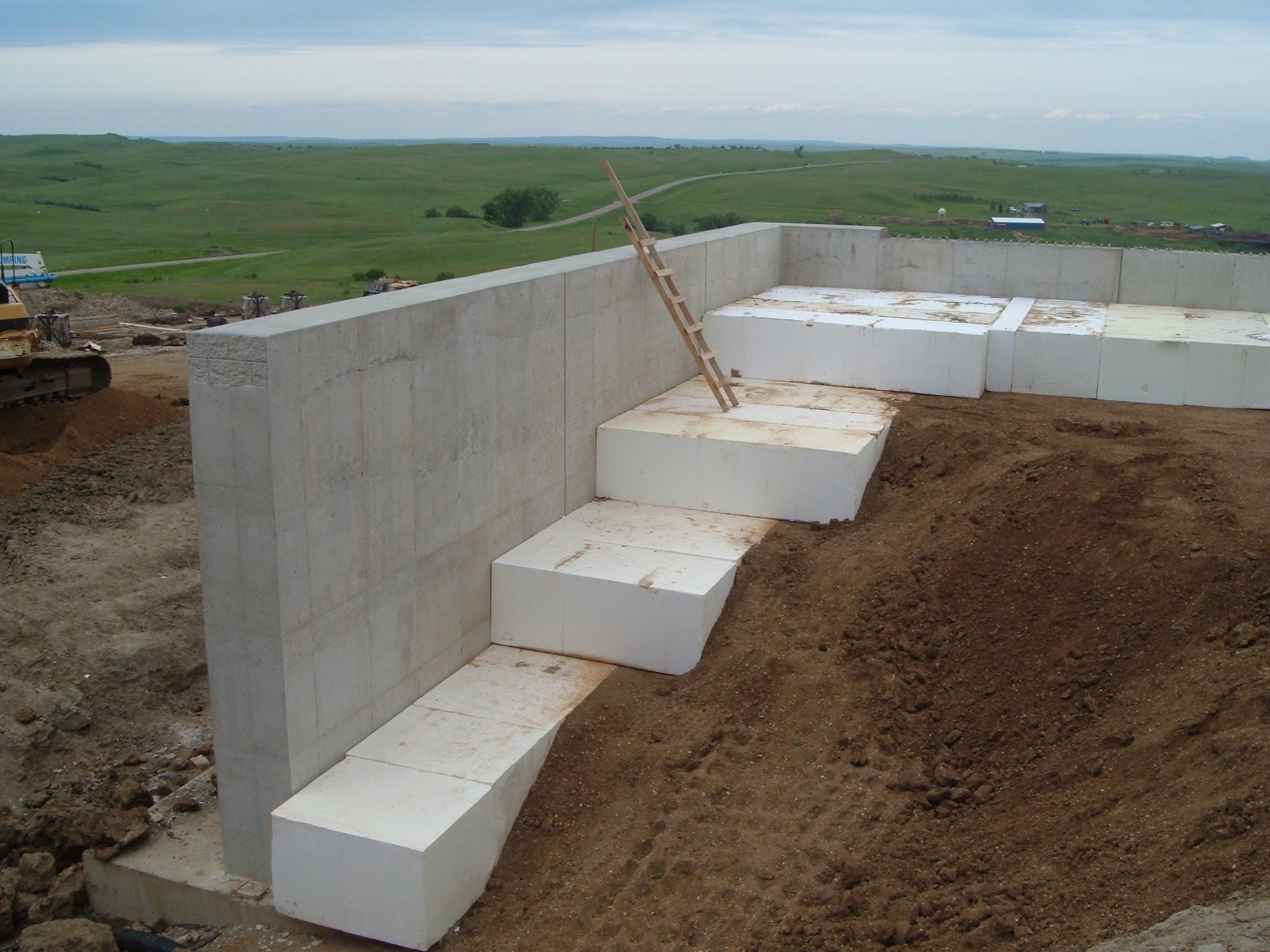
When you dig into the mechanics of a retaining wall or a building foundation, you find a simple truth. It’s all about managing weight and pressure. Soil is heavy. Wet soil is even heavier. When you pile it behind a wall or compact it to support a footing, that mass wants to move. It pushes, settles and shifts.
Geofoam blocks offer a direct solution to these challenges by replacing dense, heavy soil with a material that is strong enough to support loads but light enough to stop fighting the laws of physics.
Reducing Pressure on Retaining Walls
Let’s look at a standard retaining wall scenario. You have a vertical or near-vertical structure holding back a hillside. The soil behind it exerts horizontal pressure, what engineers call lateral earth pressure. If you build the wall strong enough to resist that push, you need massive amounts of concrete, deep footings and steel reinforcement. It is a battle of brute force.
Using Geofoam blocks as backfill changes the rules of engagement entirely. Instead of shoving tons of heavy soil against the back of the wall, you place lightweight foam blocks directly behind the structural face. EPS (expanded polystyrene) geofoam weighs about one percent of what soil weighs. When you reduce the weight of the backfill, you drastically reduce the load trying to push the wall over.
Geofoam blocks can also manage live loads and soil movement. If you have a retaining wall supporting a roadway or a parking area, traffic vibrations and pressure transfer through soil directly to the wall. Geofoam acts as a buffer. It absorbs and dampens those forces instead of transmitting them.
The material is stiff enough to hold its shape under the weight of pavement above, yet it doesn’t transfer lateral stress the way compacted clay or gravel does. This means you can design thinner walls, use less reinforcement and worry less about drainage failures causing hydrostatic pressure. In situations where you are dealing with expansive soils that swell when wet, placing Geofoam blocks between that soil and the wall gives the dirt room to expand without crushing the structure.
Preventing Settlement Under Foundations
Settlement is the enemy of any foundation. When a building cracks, doors stick or slabs tilt, it is usually because the ground underneath moved. This happens when heavy soil is placed over soft, compressible ground. The weight of the new fill squeezes the weak layer underneath, forcing it to settle.
Geofoam blocks fix this through a concept called “compensated foundations.” Instead of piling on more heavy dirt to raise a grade or build a base, you remove the weak soil and put geofoam in its place. Because the foam is so light, it doesn’t squeeze the ground below. You are effectively building without adding any significant new weight to the earth. This is incredibly valuable in areas with soft clay, peat or organic soils where traditional fill would keep sinking for years.
The foam also performs predictably. Unlike inconsistent materials like wood chips or loose rubble that have been used in the past, EPS Geofoam provides consistent and reliable mechanical behavior. Engineers can calculate how much the foam will compress under a given load. This predictability means you can design foundations with confidence, knowing the ground underneath won’t give way over time.
Real-World Performance
We see this material working in demanding conditions. When the Colorado Department of Transportation had to fix a massive sinkhole on a major highway, they used Geofoam blocks to rebuild the foundation because it was fast and it stopped the underlying soil from failing again. The foam was strong enough to support six lanes of traffic but light enough to prevent a repeat of the collapse.
At high altitudes in Utah, builders used Geofoam blocks to protect an existing tram foundation while constructing a new building next to it. They couldn’t risk adding any weight that would make the old foundation settle or move. By filling the void between the old and new structures with geofoam, they created a barrier that protected the original work without adding load.
The Takeaway
Building a retaining wall or a foundation doesn’t have to be a constant battle against weight. Geofoam blocks let you work with the site conditions rather than against them. They reduce the pressure on walls, stop foundations from sinking and provide a stable base that won’t decompose or degrade over time.
EPS Geofoam is a multi-functional solution for many applications, including those with poor soils or tight spaces. Consider that in some instances, the best way to support a heavy load is to use something lightweight.